Review of THE UNIVERSE MAKER — Or, That Same old Gnostic Hogwash Yet Again
The Universe Maker (aka the Shadow Men) by A.E. van Vogt (1953)
If you are a fan, as I am, of the disorienting and absurdly mind-expanding wonder-stories of A.E. van Vogt, then rereading this relatively obscure novelette from the middle of his career with either come as a nostalgic pleasure, or as something of a disappointment. For me, it was both.
The plot (to the degree that any van Vogt yarn can be said to have a plot) is this: Morton Cargill, a Korean War soldier on leave, picks up a girl named Marie Chanette in a bar, suffers a drunk driving accident, and walks away from the overturned car, leaving her to bleed to death.
She, or someone who looks like her, meets Cargill again. At the meeting she hands him a shining card. On the card is written the dire message that the Inter-time Society for Psychological Adjustment has determined Cargill must suffer the ‘treatment’ of being murdered. But the act of touching the card makes Cargill black out. “Her voice receded into the remote distance. There was night.”
He wakes in the Twenty-Fourth Century, in the City of the Shadows. His jail cell divided into two sections, his, and a section where a girl is watching him.
This girl turns out to be the remote descendant of Marie, and the science of the time has discovered that the neuroelectrical glandular tensions causing her neuroses were inherited genetically from the death-event of her ancestor, and can only be soothed by watching Cargill die.
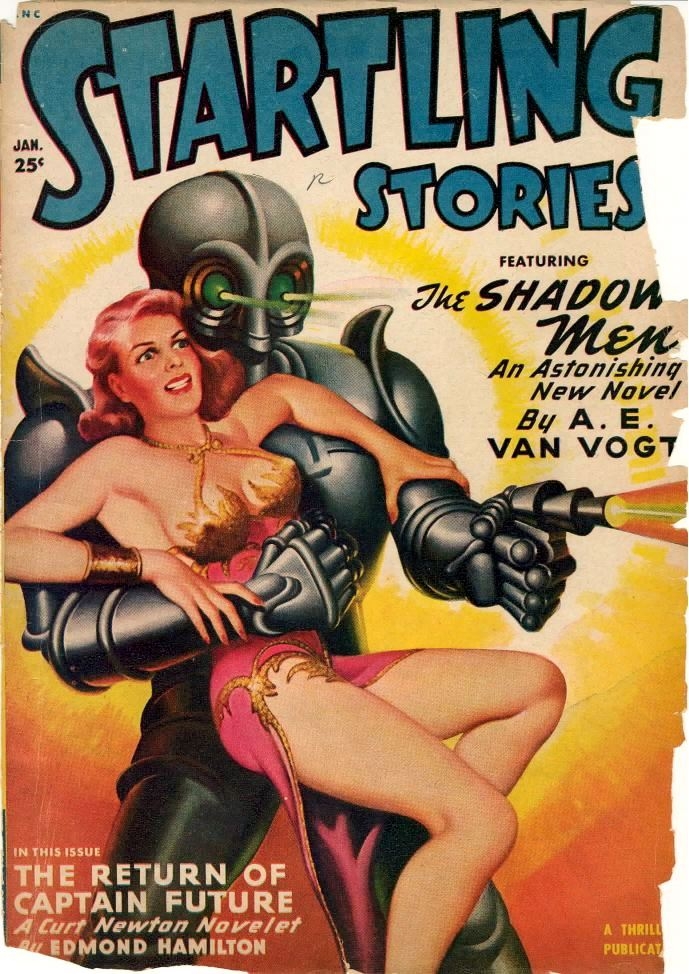
The Shadow Men by AE van Vogt
By means of a teleportation device, he is broken out of jail, and he beholds one of the strange Shadow Men, insubstantial and invulnerable, who ordered his release. The Shadow Men are unable to predict or detect his future. He is then taken aboard an airship by the nomads who spend their lives sailing idly through the air.
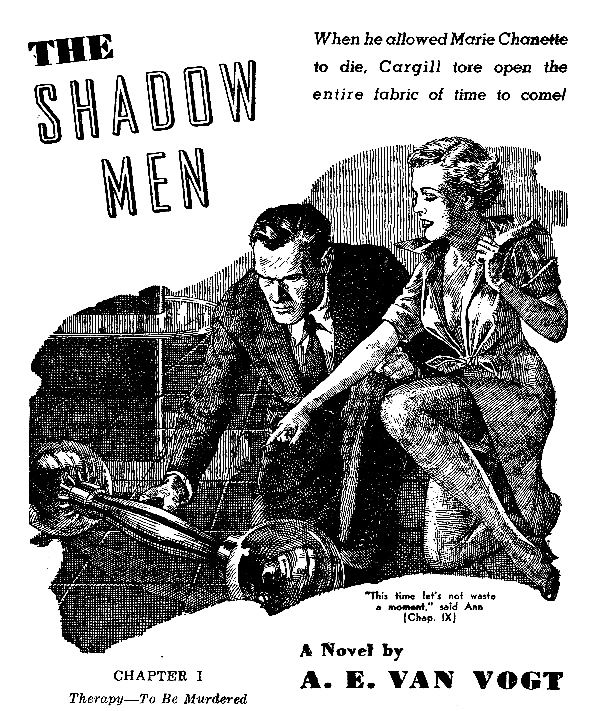
Let’s not waste a moment said Ann
Cargill becomes involved in a three-way struggled between the three groups occupying the Earth of 2391 AD.
The Floaters are listless nomads who escaped the psychological pressures of civilization, and who bob through the wilderness in solar powered airships, flying trailer-homes, pausing only to fish, capture slaves (for whom they have no imaginable use, since they have no manual labor needs) and to go to prayer meetings. These are basically the hillbillies of the future.
The Shadows are superhumans with no mental or moral flaws whatever, able to assume a shadow-form that can walk through walls, travel through time, manipulate matter and energy, and raise the dead.
The Tweeners are city-dwelling folk who were once candidates for admission to the Shadow City, but who failed. They have an incompetent airforce of superfast futuristic aircraft, but know so little of the art of war that a two-paragraph speech by Cargill, Twentieth Century soldier, not only stuns them, but makes them revise all their plans.
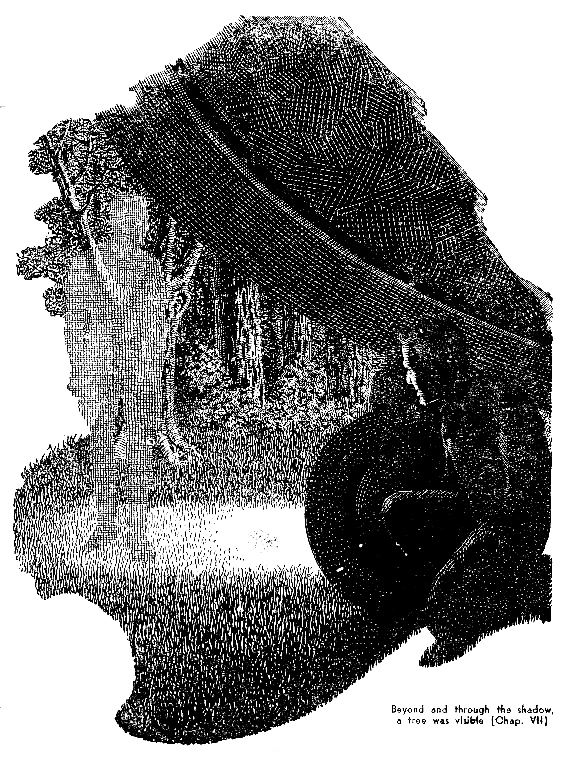
The Shadow Man — aka The Follower
Cargill is captured first by one group, then by the next, and in both cases, he seduces the nearest young female (who, for no particular reason, happens to be his jailer and also happens to find him irresistibly attractive) and then sets about, also for no reason, to establish a system of Communist-style revolutionary cells for the overthrow of their government. This attempt at revolution is particularly pointless in the case of the Floaters, who have no government. In neither case does anything come of it: in both cases, the plot point is simply forgotten by the next chapter.
Also, in both cases, the young and attractive female jailer is religious.
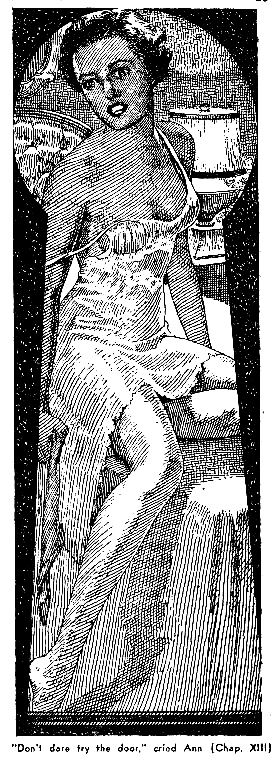
Cheesecake! 1950s Sci-Fi Style
In both cases Grannis, the mysterious figure from the Shadow City, reappears. When Cargill is among the Floaters, Grannis attempts to have him recaptured and returned to the Shadow City. When Cargill is at the Shadow City, Grannis sends his agent Anne Reece to break Cargill out of captivity a second time, so that he can aid the Tweener attack on the Shadow City. When Cargill is among the Tweeners, Grannis orders Cargill to seduce Anne Reece as the most efficient method of stopping the attack on the Shadow City.
The Tweeners have two plans for Cargill, each logically incompatible with the other. One is to have Cargill advise their military and direct the training of their air force for the attack on the Shadow City. Why he, as an infantryman, would know more about air war than the people living in his future is not clear. Perhaps the collapse of civilization after the departure of the population for lives of ease as Floaters has banished the practice of war which the Tweeners are attempting to relearn.
The second plan is to use their futuristic energy-tube technology to imprint onto his brain an unbreakable and inescapable hypnotic compulsion to enter the Shadow City, find the system controlling the energy pyramid protecting the city from air raid, and shut off the defenses. This brain-imprinting is so precise and so delicate that Cargill walks and talks as normal, and he cannot even act oddly or out-of-character so as to bring attention to himself. The first plan assumes he is cooperating willingly; the second assumes the opposite.
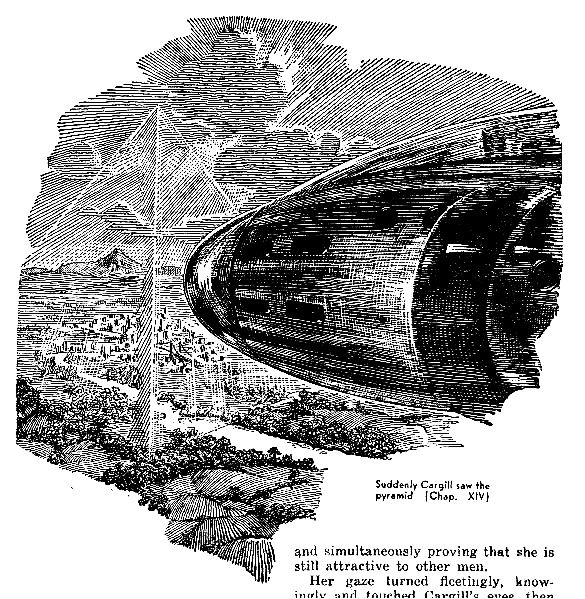
Suddenly Cargill Saw the Pyramid
(At no point is it mentioned where these controls are: I was picturing a big double-throw switch humming merrily to itself, unguarded and unwatched, with no failover or backup system, perhaps in an unlocked shed near the main power station, with a convenient sign telling visitors from previous centuries where to find it.)
While among the Tweeners, Cargill suffers two dreams or memories from a previous or future lives or ulterior condition of being. In one, he beholds the universe as a golden dot shedding galaxies, and sees relics of attempts at creating life, a statue and then a lake of deathless yet incomplete manifestations of the cosmic life-principle. In the second dream he beholds a future of a paradise-city called Merlic, and he told by one Lan Bruch of 7301 A.D. that the timeline leading to Merlic is ghostly and insubstantial. Merlic will not come into existence unless the Shadow City is destroyed.
Cargill is sent to the Shadow City, which turns out to consist of friendly and energetic people. He tries to look up Grannis, the shadow-man who is the traitor, but there is no such name in their directory.
He receives their training, which consists of one short lecture of two or three paragraphs, and an electronic imprint on his brain. He is now able to assume a shadow-form, turn insubstantial, travel through time, and so on. The fact that his is hypnotically conditioned to shut off the energy pyramid is conveniently forgotten: when or if he escapes this inescapable compulsion is not mentioned by the author.
He emerges from the training to a celebration, and discovers that he has been elected leader and ruler of the Shadow City. The time travelers vote for a leader after his term of office is up, and only then send the results back to the election day in the past. Like the leader of Rome being called Caesar, the ruler of the Shadow City is Grannis, which is the name of the office, not the name of a person: Cargill discovers he is Grannis.
He is escorted into the office, shakes hands with the previous Grannis, and then abruptly is left alone. There is no inauguration or swearing in ceremony, no transition team, not even a briefing on what the buttons on the desk do. He is the leader of a city full of superhumans, but no one needs to talk to him. He experiments with his new powers.
By concentrating on the note of high C, Cargill-Grannis establishes a vibration which allows him to travel back in time. (If that last sentence strikes you as almost dreamlike in its unlogic, I assure you, dear reader, that reading the description by van Vogt in context will not abolish your impression.)
Cargill-Grannis then goes about establishing the various pointless conspiracies against himself needed to organize events to bring about the pointless results those conspiracies brought about.
He allows himself to be murdered as part of the therapy for the jangled nerves of the descendant of Marie Chenette (remember her?) and, while dead, enters the condition of being recalled from his dreams, where he is at one-ness with the spiritual life-principle extending throughout the cosmos.
He achieves enlightenment, and discovers that all reality is an illusion created by the life-energy in order for life to have possessions and for life to fulfill a primitive need for punishment and retaliation. Having possessions is what creates time; the neurotic need for retaliation or revenge is what creates the illusion of death; and God is merely Grannis and the various other enlightened aspects or parts of the one primal and timeless energy field. The universe is but a game, and the players have forgotten the reason for the play, or even that it is a game and that they are players.
Cargill-Grannis discovers he is not responsible for the death of Marie Chenette: she was killed in a different car accident and her body merely teleported into Cargill’s car by Cargill-Grannis. Older-he implanted the hypnotic suggestion that younger-he met her in the bar in younger-his brain. However, when Cargill-Grannis attempts to alter events to save her life, the universe is accidently destroyed, and so the innocent girl must die in order to restore and re-create the structure of spacetime and reality.
He allows her to die, the cycle of the universe starts again.
So much for the plot.
As bit of mind-blowing flimflammery, van Vogt even on his off days has the happy ability to stun the unwary reader with awe-inspiring yet understated lines, such as “We had to have somebody from a time far past so the Shadows couldn’t use their four-dimensional minds on him.” The plot has enough twists and paradoxes to satisfy all but the most demanding readers of van Vogt.
If you like this sort of thing (and I do) you’ll like this book (and I did).
I will not dwell further on what I admired about this book—the virtues of a van Vogt book cannot be described to those who are not fans of van Vogt, and need not be described to those that are.
I did not enjoy it as much I had once. Part of the disappointment can be traced merely to a change in me, the reader, not to any flaw (or, to be precise, any new flaw) in the original work.
But four things my teenaged self did not notice or did not care about now irked my grown-up eyes: first, the less than admirable moral stature of the protagonist; second, the repetition of certain themes and scenes which were to be used again in PLAYERS OF NULL-A (1956); third, the dangling or pointless plot points; and fourth, the ham-handed handling of theme of religion.
Let us take these discontents in order. First, Cargill is a cad, if not downright sociopathic.
Van Vogt’s works can be divided, if not chronologically, at least thematically, into two types of tales. His typical early work concerned heroes who were secretly superhuman, usually amnesiacs, struggling against time paradoxes and against implacable yet hidden enemies in conspiracies of planetary or cosmic significance. His typical later works concerned antiheroes or outright wretches whose psychological defects, usually related to sexual neurosis, were a central part of the story.
SLAN, WORLD OF NULL A, and WEAPON SHOPS OF ISHER, are typical of his superhuman theme—the protagonists are telepaths, teleports, or immortals. Also in the superhuman theme can be found in THE SILKIE, THE MOONBEAST, THE MIXED MEN, TWO HUNDRED MILLION A.D.—The protagonists there include a an energy-controlling spacetraveling shapechanger, a totipotent man, a race of mesmerists, and a god.
On the other hand, MAN WITH A THOUSAND NAMES, THE DARKNESS ON DIAMONDIA, EARTH FACTOR X, THE VIOLENT MAN and COSMIC ENCOUNTER (also published as THE UNIVERSE ENDED IN 1704 AD) are typical of his subhuman themes. The wretches include a sociopathic liar, a planet of violence-addicted males, an insanely jealous wife-beating womanizer, a womanizing violence-addicted male, and a pirate.
THE UNIVERSE MAKER falls squarely between the two. Morton Cargill, the protagonist, is not as psychologically damaged a subhuman as Steven Masters from MAN WITH A THOUSAND NAMES, but he is no Gilbert Gosseyn nor Jommy Cross either.
The man is both a drunk and a womanizer, indeed, a cynical manipulator of women, none of whom he has the least affection for nor interest in.
Chaste science fiction yarns of the 1950’s did not describe sex scenes, but they were allowed to imply the unwed sexual liaisons that took place offstage. In this case, the implication is made by having the women, once conquered, evaporate from the plot, taking all traces of personality with her. Even the forgettable and interchangeable sexual conquests of a James Bond film are treated with more realism and respect than those of Cargill—not a single word or thought of tenderness passes from Cargill toward the female-shaped non-entities he seduces, and, once seduced, are rushed offstage or into nonbeing (the shack-up with Lela Bouvy, for example, is retroactively redacted by time paradox).
Cargill displays equally emotionless cynicism when attempting to establish political revolts and revolutions among the menfolk, which, as far as I can tell, is merely a neurotic habit of his, since nothing ever comes of his two attempts to do so.
As with the loveless seduction of women, nothing like patriotism or even the degraded idealism of the Communists passes his lips or his thoughts when manipulating men to revolt. He is merely able to command the menfolk of other times to violent and desperate overthrow of their lawfully established government for no particular reason, and when hesitation is displayed on the part of the conspirators, Cargill threatens to betray them to the police. Apparently having them arrested or killed in order to brace them for their violent revolutionary overthrow of the regime is perfectly acceptable. At least, no one, neither Cargill nor anyone else, expresses reservations about this casual act of treachery against men who, one assumes, trust him as their cell leader.
Now, this would not be so bad, if Cargill throughout were a calm and calculating manipulator of men and seducer of women—he would be an admirable anti-hero, a genius like Fu Manchu or Doctor Doom. But, no. He spends the first five chapters in such a state of emotional disequilibrium that he merely staggers from scene to scene. The author describes his internal mental commotion as so great that he can barely see or hear what is going on around him: he is practically a Lovecraft protagonist, always on the verge of fainting.
Second, having just recently reread PLAYERS OF NULL-A, I was acutely aware of the parallels here.
Like Cargill, the hero of PLAYERS, Gilbert Gosseyn, picks up a calling card from the Shadow Man called The Follower, the moment he touches the card he is trapped. His black out is described with the same words: “For then it was night.” He wakes in a split jail cell where a woman is looking on, and he is waiting to be murdered. The shadow-man figure announces that his future, and his alone, cannot be predicted. He escapes by means of teleportation, and is taken aboard an airship by an aristocrat of the class that spend their lives sailing idly through the air.
Now, every writer borrows from himself or revisits themes and ideas not completely explored in previous works, and usually readers don’t mind. A fan of Robert Heinlein or Isaac Asimov would be pleased rather than the reverse to read another novel about omni-competent yet sexually liberated Martian mobile infantrymen in power armor or about psychohistorians with positronic brains. But in this case even certain phrases and descriptions were recycled.
Third, the plot points left dangling include (1) why Cargill, and no one else, happens to be the one being able to achieve enlightenment and total control over the universe, (2) what happens to the political revolutions he sets in motion (albeit the first one was perhaps wiped into nonbeing by time paradox), (3) whether we are supposed to assume that the entire Tweener war effort consisted of one hypnotized dupe and a small flotilla of aircraft, and that once Cargill turns into Grannis, the Tweeners are impotent to try again, (4) why Cargill is able to ignore the allegedly unbreakable hypnotic compulsion of the Tweeners, (5) why if his future actions and his alone cannot be predicted by the Shadows he is elected as their leader — since such an election requires a report or prediction from the future as to how his actions succeeded, and (6) why any of these events had to happen, since time travel should have prevented them.
The explanation that these things had to happen because they had to happen is not really very satisfying.
This last problem is not confined to Van Vogt alone, but plagues every science fiction author who takes up the pen to produce a time paradox story. A story where your hero is flung back into the Court of King Arthur, or the siege of Troy, or the Dinosaur Age, so that he can cross swords with Mordred or shoot a Brontosaur does not necessarily involve a paradox. But a story where your time-traveling protagonist crisscrosses his own past with his own actions, or (as here) causes those actions runs into a problem inherent in the nature of drama.
Drama fundamentally requires free will: a description of the fall of raindrops or the action of intermeshing mechanical gears might be stirring or sublime or poetical, but a mere description is not drama. Drama is conflict. In order for the conflict not to be a cheat, there has to be some chance of success and some chance of failure.
But if the theory and practice of time travel lands the reader in what we might call a Calvinist universe, where the events unfold as they do because the time traveler unfolds the events as they do in order to create the events that unfolded as they did, there is a curious deadness to the drama: nothing actually happened for any reason.
Even a Greek Tragedy that takes place in a universe where fate is determined and inescapable is not as dead and pointless as a time-paradox story where nothing has a reason: in the Greek Tragedy, as in the tale of Oedipus, the hero’s attempt to escape fate bring about what most he fears, and the drama consists of peeling back the revelations, one by one, as he realizes who he really is and what he really has done.
I can recall more than one time paradox story where this snake-tied-in-a-Celtic-knot-eating-its-own-tail sort of theme managed to avoid the undramatic implication of past events being caused by future events for no reason: but this story is not one of them. Morton Cargill aborts what is apparently the glorious future of Merlica, and fails to save Marie Chanette, for no reason other than that fate and history so dictate, but the author grants (or seems to grant) Cargill the power and authority to alter fate and history.
Fourth, the treatment of topic of religion in this short novel is so superficial, artificial, and condescending as to be risible. My reaction reading this was merely to wonder whom the author trying to kid, himself or his readers.
Chapter VI opens with a hillbilly preacher punching Cargill in the face for trying to marry Lela Bouvy, but the preacher is looking for a bribe, and refuses to perform the wedding when no bribe is forthcoming, but he threatens Bouvy with ‘the wrath’ if she fornicates with Cargill, which she then immediately does. This scene has no purpose except to introduce these thoughts of Cargill’s:
He considered most of the religious people he knew hypocrites. The implication of believing one was a soul, or had one, were so numerous that anything short of acting on those implications made belief a mere protective coloring. Cargill knew of no one who showed by his actions that he believed himself to be an infinitely tenuous energy structure united to a material body.
I shall not dwell on the shallowness of Cargill (or the Author’s) analysis of the sincerity of the saints of the West and the sages of the East except to say that no one aside from some New Age crackpots defines the souls as being an infinitely tenuous energy structure united to a material body. There have been enough philosophers and saints, from Aquinas to Descartes in the West, to Vyasa to Buddha in the East speculating or revealing the nature of the soul for anyone to notice what the topic is and is not. The saints and sages are not talking about something one can measure with a voltmeter.
In the same chapter, Cargill further scoffs at the assumption by the minister and his dimwitted flock (including Lela) that the minister has the power to call down the wrath of God to punish the unfaithful. The tin-earned and flatfooted nature of this denunciation strikes me as merely ignorant: as if the author thinks preachers are the same thing as magicians, and claim the authority to make God punish the wicked, or make God do anything, and has never been to Sunday school long enough to hear any other account.
But the passage goes on:
What was astonishing that each (Lela and the preacher threatening her) accepted, somehow, that souls were involved, and that punishment was possible on the soul level.
“Suppose,” Cargill thought, “there is a soul or at least that behind all the excitement of fifty thousand years of soul-hunger, there is actual phenomena?”
It was hard to imagine that the reality had ever been more than vaguely glimpsed. People had been too rigid. All too frequently the vast powers of the state had been used to enforce an inflexible set of beliefs. And, where a breakaway was not mere denial, the individuals somehow assumed they believed in a simple soul state-of-being. In connection with this, the word ‘immortal’ was bandied about in such a loose fashion that it was instantly evident that no one had ever seriously thought about it.
Gee, Cargill, ya think? No one from Abraham to Moses to St. Paul to Confucius to Lao Tzu to St. Francis of Assisi to Mahound to Richard the Lionheart to Kierkegaard has ever seriously thought about the soul? The Buddha and Prince Arjuna never seriously thought about the idea of immortality? No martyr and no missionary ever took his beliefs earnestly enough to act on them, or to perform an action which only makes sense in the context of believing the soul to survive bodily death? Not only has this never happened, but it is instantly evident that it never did? Tell that to St. Stephen when you see him.
Religion is mentioned briefly again in Chapter IX reference to some history of the Twenty-Second Century:
The fall of Sovietism produced a resurgence of religion on a singularly primitive level. It was a feudalistic disaster, product of the unusual fears of a mentally sick hierarchy, uncreative, and so completely suppressive that the genius of half the people of the earth had already been lost for two hundred years.
Kudos to van Vogt circa 1953 for foretelling the fall of the Soviet Union. His batting average as a predictor is better than that of the Co-Dominium novels by Jerry Pournelle. But notice that religion is mentioned only in the most scathing terms primitive … feudalistic … fears … mentally sick … uncreative… suppressive et cetera and ad nauseam. Notice that no religion aside from one (we know which one that is, do we not?) is mentioned or implied. It is not a Buddhist Roshi nor a Shinto Shrine Maiden nor even a Sufi Dervish who socks Cargill on the jaw, talks in hillbilly slang, and tries to get a bribe.
There is no mention of any religious order or religious person giving to charity, running a hospital or soup kitchen or founding a school.
Let me quote a final passage at length. This concerns the Tweener rationale for the war against the Shadows.
She flared: “Imagine changing the past, so that people gradually become more civilized, get over their neuroses, and all that nonsense. It’s against reason, against — religion.”
“Religion?” said Cargill, remembering his own speculations. “Do you believe in the soul?”
“God is within everyone,” she said.
Cargill had heard that one before. “People keep saying that,” he said, “but then they act as if they don’t mean it. Let’s just assume for a moment that it’s true.”
“Of course it’s true.” She was impatient. “What do you mean, assume?”
“I mean,” said Cargill, “let’s assume it as a scientific fact.”
She was silent. A wary expression came into her face. Cargill knew that look. He had seen it in the eyes of the chaplain of his company, and in the faces of other people whenever the subject of their belief was pressed too hard.
“Scientific?” she said, and she made it a term of opprobrium.
Cargill laughed. He couldn’t help it. Her house was filled with ‘scientific’ equipment … but now he had applied the term to a forbidden area of thought.
He ceased his laughter with an effort, and said soberly: “I’m honestly beginning to believe that I’m the only person who really thinks the soul might exist. My picture of it is perhaps a little more wonderful than that of even those who give lip service to the word and to the idea behind it. At first, I thought it might be an energy field in space-time, but that doesn’t quite take into account the vast age of the universe … it would be easy, on the basis of the estimated age of the universe, to make all religions look ridiculous, but that isn’t what I want to do. I am guessing that all this smoke has a hot fire under it somewhere, but the understanding we’ve had so far is just a superficial glimpse at the underlying reality. What do you think of that?”
“I really don’t care to discuss the matter, Mr. Cargill.” She was cold. “Your childish speculations are not exactly an insult, since you do seem sincere; but they ignore a thousand years of religious thought.”
“You mean,” said Cargill, “ten thousand years of making the effort not to know, of belief enforced by just such an attitude—and never a good look at what might actually be there…”
I quote this passage in full because otherwise I doubt I could convey the true level of smugness and larded smarm, the sheer sophomoric arrogance and idiocy of Cargill’s character.
The author has Ann simply bristle at the mention of science. The topic is ‘forbidden.’ Better yet, Ann’s religion (which bears no relation to any religious writings I have ever read) is opposed to improving civilization and decreasing neurosis. I assume this hooey was written for people who know nothing about any religions except what they see on Carl Sagan’s COSMOS, where religion is portrayed as an utterly pointless sect of science hating science haters, and there is nothing more to it than that.
Then Cargill proudly announces, based on nothing and on no qualifications, that a Korean war vet with no particular scientific or theological or historical or psychological knowledge, training, insight, or ability is going to overthrow all exoteric religions and achieve the ultimate knowledge of all things spiritual on a scientific basis.
In other words, Cargill here declares himself to be the next Isaac Newton, except in the field of theology rather than physics, or the next Mary Baker Eddy, who will set about to revolutionize religion on a scientific basis, but he displays neither the sobriety of a Newton (who gave due credit to those giants on whose shoulders he rose) nor the respect for the Gospel of a Christian Scientist. Like a flat-earther or a moonlanding-on-a-soundstage conspiracy nut, he just announces that every previous man, woman and child in existence was incompetent or willfully blind.
He comes across like a pompous jerk. But, since this is his story, and the author can award him whatever insights or power as need be, let us see what wondrous revolution in religious insight is given us by the end of the character’s scientific investigations, shall we?
Except, of course, that the character makes no scientific investigations of the reality of the soul of any kind whatsoever. Even the Shadows, who have the technology to raise the dead to life again, know more of these things that does he, and if Cargill at any point is made aware of what their research results have been, in it not evident in the plot.
Cargill’s discoveries are handed to him with no effort on his part by the author, who thoughtfully provides him with a dream and then an out-of-body near-death experience where Cargill recalls that time is an illusion created by the desire of souls to possess things, and that death is an illusion created by the desire of souls for punishment and retaliation. The universe itself is merely a game created by the spirit forces of the life-energy, and the players have forgotten that they are the makers of rules rather than those bound by the rules.
These dreams and out-of-body experiences are simply dropped into the middle of the plot, more or less without warning. There does not seem to be any reason why they visit Cargill as opposed to someone else. But suddenly he has figured out the secret of the ages.
Then, in the final line it is announced that all authority under heaven and earth is given unto Cargill, amen, with these words:
“I’ve broken through the barriers of life and death. The whole sidereal universe is open to me now that I know the truth.” Satisfied, he returned to Shadow City. The cycle was complete.
Now, I did not recognize the philosophy being expressed when I first read this book as a child. But then I also read VOYAGE TO ARCTURUS by David Lindsay, which mentions a similar Pleroma from which all spirits derive, and are trapped, having forgotten their true source and true home. I read the AEGYPT series by John Crowley, where the philosophy is laid out in precise yet lyrical terms. I read CHILDHOOD’S END by Arthur C. Clarke and THE GOLDEN COMPASS by Phillip Pullman and THE LITTLE PRINCE by Antoine de Saint Exupéry. I had also seen the movies DARK CITY and THE MATRIX.
So, now, rereading THE UNIVERSE MAKER with more experienced and perhaps more jaundiced eyes, eyes not as wide with wonder as when first I read, of course I recognize the universe that Cargill discovers:
It’s that same old Gnostic hogwash yet again.
If you have not come across this idea over and over again, dear reader, you cannot share my weariness with it.
Perhaps the first time a teenager thinks that perhaps God is a deceiver who has trapped the real gods, namely your wonderful teenage self and all your self-adoring wondrous wonderfulness, the idea is startling, almost deliciously blasphemous, yet luminous with the promise that it might just be true. Perhaps exoteric and doctrinal religion is not just evil but ee-evil, and your esoteric insights, ineffable feelings, dreams or fancies are good and true, the voice of truth that needs no-one and nothing else.
But upon hearing the tenth or the hundredth repetition of the idea, with nothing new to add to it, and nothing to detract from its glaring shortcomings, the fanfare begins to sound tinny.
One is reminded of ads in the back of old comic books for x-ray goggles. If the goggles actually worked, don’t you think the manufacturer would have something better to do than sell them for kids who read funnybooks? If Gnosticism was the secret of the universe, don’t you think the secret rulers of the universe would have something better to do than share the secret with you? And if a crummy stumblebum like you is the one and only true and supreme God, there is not much to hope for, and nothing worth worshiping in your Creation, is there?
Even the threefold division of the society of 2391 A.D. takes on a Gnostic luster. Gnostics divided the world into three types of souls, the hylic or mundane, those concerned only with bovine earthly pleasures, the psychic or intellectuals, concerned with things of the mind, and the pneumatic or spirituals, concerned with the ineffable realities beyond mere reason. The Floaters are the hylics; the Tweeners are the psychics; the Shadows are the pneumatics. Seriously, I doubt if van Vogt studied Gnostic esoterica and established this tripartite division deliberately, but there is something about gnosticism that lends itself to supercilious disparagement of the common man and his pleasures, or the intellect and its efforts.
Gnosticism is a very simple, and, upon examination, a very stupid concept.
The concept is that you are wonderful and your sins are wonderful and anyone trying to free you from the chains of your sins is actually, really an enemy trying to repress and smother your wonderfulness.
If only you can break out of the trap of the material universe by defying and denying the ee-evil religion your mother taught you at her knee, that ee-evil religion filled with chastity and self-control and self-denial and chivalry and manliness and all-consuming love and saintliness, that not only will your wonderful self be free to gamble away the family fortune, sleep with whores, and drink yourself blind-drunk, your wonderful self will be restored to your true position as a god above God. If you merely eat the Turkish Delight, you will be High King instead of your mean older brother Peter. If you merely eat of the forbidden fruit, you will be like God, and He, in His jealousy, seeks to deny you your birthright.
This idea is lame and moth-worn enough even when presented with earnest sobriety, as it is in VOYAGE TO ARCTURUS, or when presented without undue self-aggrandizement or Christophobia, as it is in AEGYPT, it is still wearisome.
But when, as here, we the readers are presented with the asinine crowing cocksureness of a man who claims that he and he alone truly believes the soul exists, and that everyone else in history was not just wrong, but primitive, obtuse, hypocritical and stupid—then, after all this fanfare and trumpet-blowing and clashing of cymbals and promises of greatness, we get, not the Messiah, but just Simon the Magician, pulling cards out of his threadbare sleeve, and trying to pull a trick that was tired and worn in the First Century A.D. when it was first tried, the anticlimax cannot get more anticlimactic.
Gnostics, unlike heterodox saints, do not actually ever do anything that benefits anyone else. Here Cargill-Grannis, super-enlightened superbeing, finds he cannot save even one innocent barfly. Cargill announces that the entire universe is open to him, but he cannot heal the sick or raise the dead.
Through no merit of his own, he is not merely allowed to enter the Shangri-La of superscientific utopia of the Shadow City, and granted enlightenment, godhead, and power beyond imagination, he is also selected by fate to be leader and lord of that city. It is puerile adolescent wish fulfillment fantasy: I HAD TROUBLE GETTING TO SOLLA SOLLEW by renowned science fiction author Dr. Seuss has a somewhat more realistic conclusions.
Indeed, the youth from the valley of Vung who is our protagonist in Dr. Seuss at least makes a concerted and sustained effort to find Solla Sollew, by the beautiful banks of the river Wah-Hoo, where they never have troubles, or, at least, very few.
In contrast, Cargill merely stumbles blindly from one captivity to another, seducing women and men, and boasting about how much smarter he is that the godbotherers.
His only actual “actions” in the book are (1) his first attempt to run blindly into the woods from his rescuers (whereupon he is immediately captured and enslaved, recaptured and re-rescued whereupon that whole sequence of events is time-aborted) and (2) his attempt to foment a revolt among the Tweeners (which comes to nothing). A Messiah should at least be tempted forty days and nights in the wilderness, or have to pass the test of the Gom Jabbar, or something.

Satisfied, he returned to Shadow City. The cycle was complete.
Is there anything really wrong with puerile adolescent power fantasy? I sure hope not. Puerile adolescents need something to read on rainy days, and I like a fantasy as much as the next fanboy.
Is there any wrong with Gnostic hogwash? Lots of things, but if you are writing a paranoid supernatural conspiracy yarn, no conspiracy can possibly be bigger than one that involves God, nature, and all of timespace.
Anything wrong with a few loose plot-threads here and there? No fan of Van Vogt would dare declare that a dangling plotline or two is fatal to a tale.
Anything wrong with recycling some ideas and images? Considering that the trapped calling cards, shadow-men, sky trailers and unpredictable heroes were used to much better effect in a later novel, I would actually congratulate Van Vogt for lifting the more interesting material out of this lackluster novel for use in the sequel to WORLD OF NULL-A, where it was displayed to better advantage.
But all these annoyances taken together diminish the book, and even nostalgia and fannish loyalty to this author cannot overcome all weak spots. The book is not that good.
For all my complaints, I cannot condemn the book as bad. Any novel where the main character accidentally destroys and recreates the universe at least has the audacity of scope in its favor. But, by all means, read some of the van Vogt’s better works before you track down this particular short novel.
It is not his best.

About John C Wright
John C. Wright is a practicing philosopher, a retired attorney, newspaperman, and newspaper editor, and a published author of science fiction. Once a Houyhnhnm, he was expelled from the august ranks of purely rational beings when he fell in love; but retains an honorary title.
